
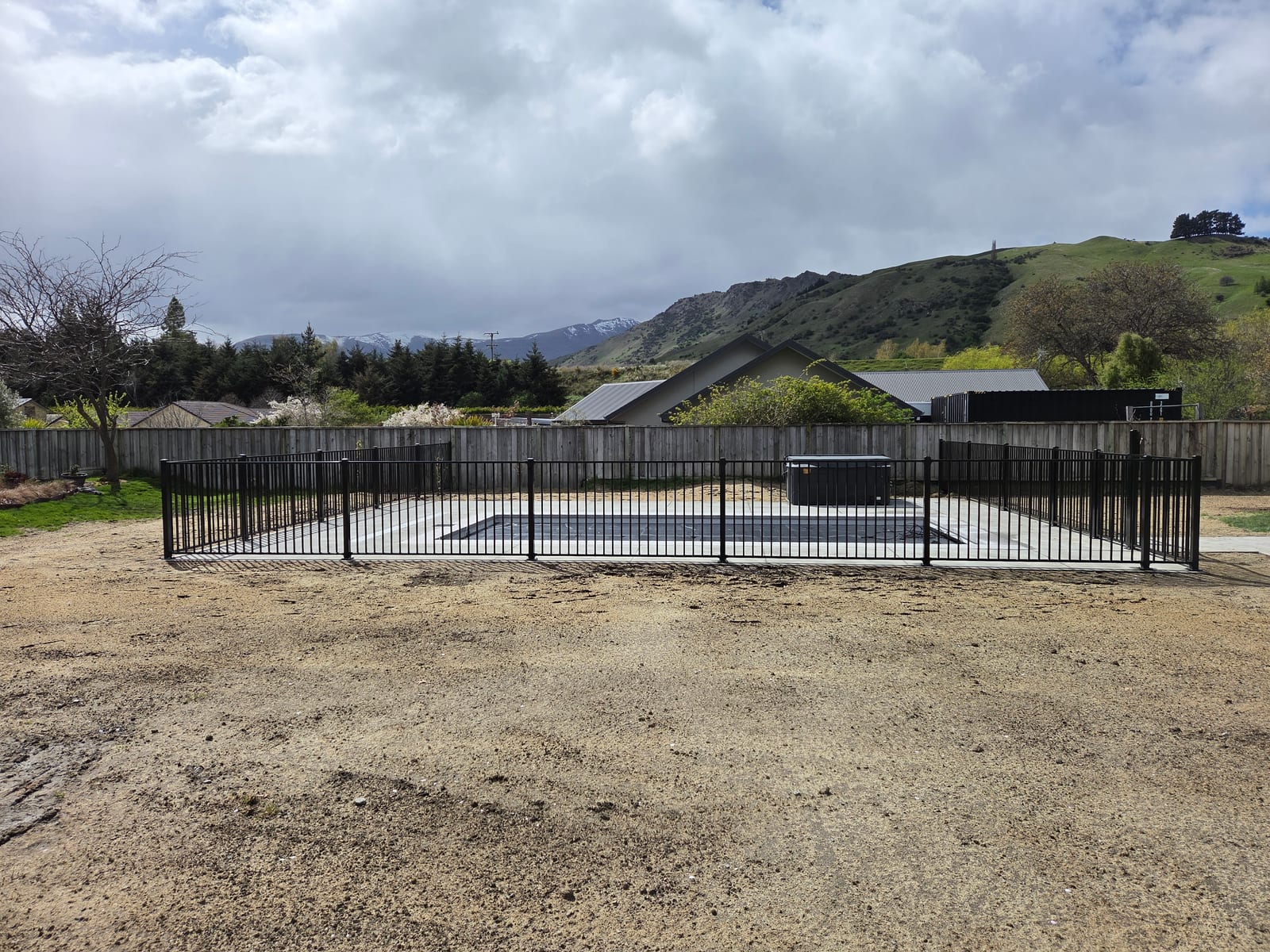
If you have a swimming pool or spa pool in New Zealand, you are legally required to have compliant fencing around it. The rules are stricter than many homeowners realise, and getting it wrong can mean a failed council inspection and having to redo the work. Here is what you need to know.
The Law
Pool fencing in New Zealand is governed by the Fencing of Swimming Pools Act 1987 and the Building Act 2004. Any pool or spa that can hold 400mm or more of water must have a fence that restricts access by young children.
The law applies to all residential pools, whether they are in-ground, above-ground, or temporary. If your pool can hold 400mm of water, you need a compliant barrier. There are no exceptions for small properties or older homes.
What the Fence Must Do
The fence needs to create a complete barrier between the pool and the rest of the property. Key requirements include:
- Minimum height of 1.2 metres on the outside face, measured from ground level
- No climbable objects within 1.2 metres on the outside of the fence: this includes garden features, furniture, and even vegetation
- Maximum gap at the bottom of the fence is 100mm
- Vertical elements must have gaps no wider than 100mm between them
- Gates must be self-closing and self-latching, with the latch positioned so a child cannot reach it from outside
The Self-Closing Gate Rule
This is the area where most pool fences fail inspection. Every gate in a pool fence must:
- Close and latch automatically from any open position
- Open away from the pool (so it cannot swing open towards the water)
- Have the latch on the pool side, positioned at least 1.5 metres from the ground or within a release zone that a child cannot reach
A gate that is propped open, or a latch that does not catch reliably, will fail. We always use quality self-latching hardware and test every gate before we leave the site.
Frameless Glass vs Steel vs Aluminium
Each material has its own advantages for pool fencing:
- Frameless glass: the most popular choice in Queenstown right now. Looks premium, does not obstruct the view, very easy to clean. Can be more expensive upfront but adds genuine value to a property.
- Semi-frameless glass: posts at regular intervals with glass panels between. Slightly more affordable than fully frameless, still looks great.
- Steel or aluminium tubular: durable and cost-effective. Available in black or other powder-coat colours. A solid option for most properties.
Council Inspections
Once your pool fence is installed, your local council will need to carry out an inspection. In Queenstown, this is handled by the Queenstown Lakes District Council. You are required to notify the council within five working days of filling your pool for the first time.
Councils also have the right to inspect pool fences at any time. If your fence is found to be non-compliant, you can be required to fix it within five days. Continued non-compliance can result in a fine of up to $200 per day.
Getting It Right the First Time
We have installed pool fencing across Queenstown and Central Otago since 2013. Every fence we build meets the requirements of the Fencing of Swimming Pools Act. We know the common failure points: the gate hardware, the clearances, the climbable objects. We build around them from the start.
If you are unsure whether your existing pool fence is compliant, or you are building a new pool and need fencing sorted, give Nate a call on 021 228 6735 for a free assessment.
Need a pool fence quote?
Free, no-obligation assessments across Queenstown and Central Otago.